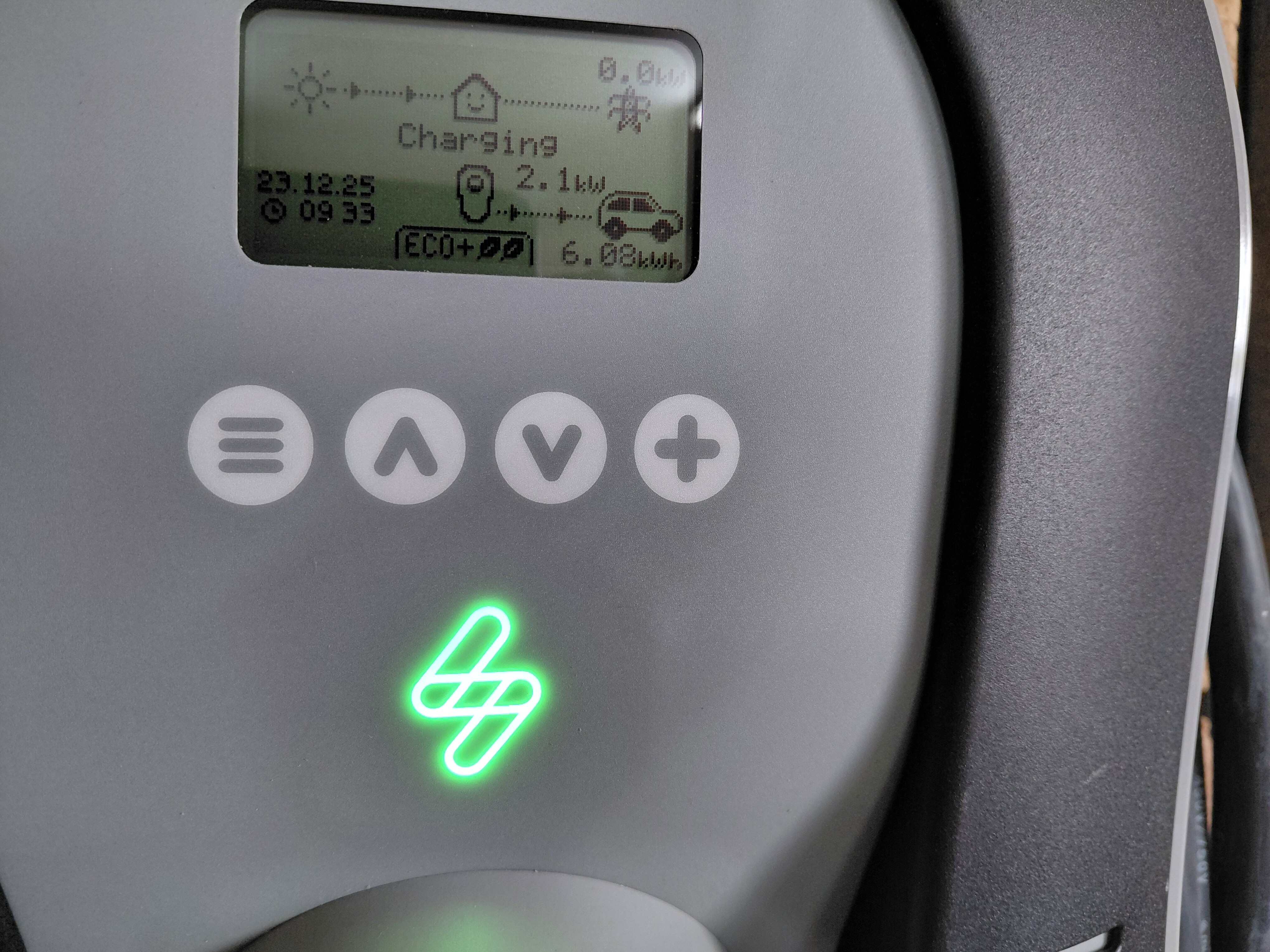
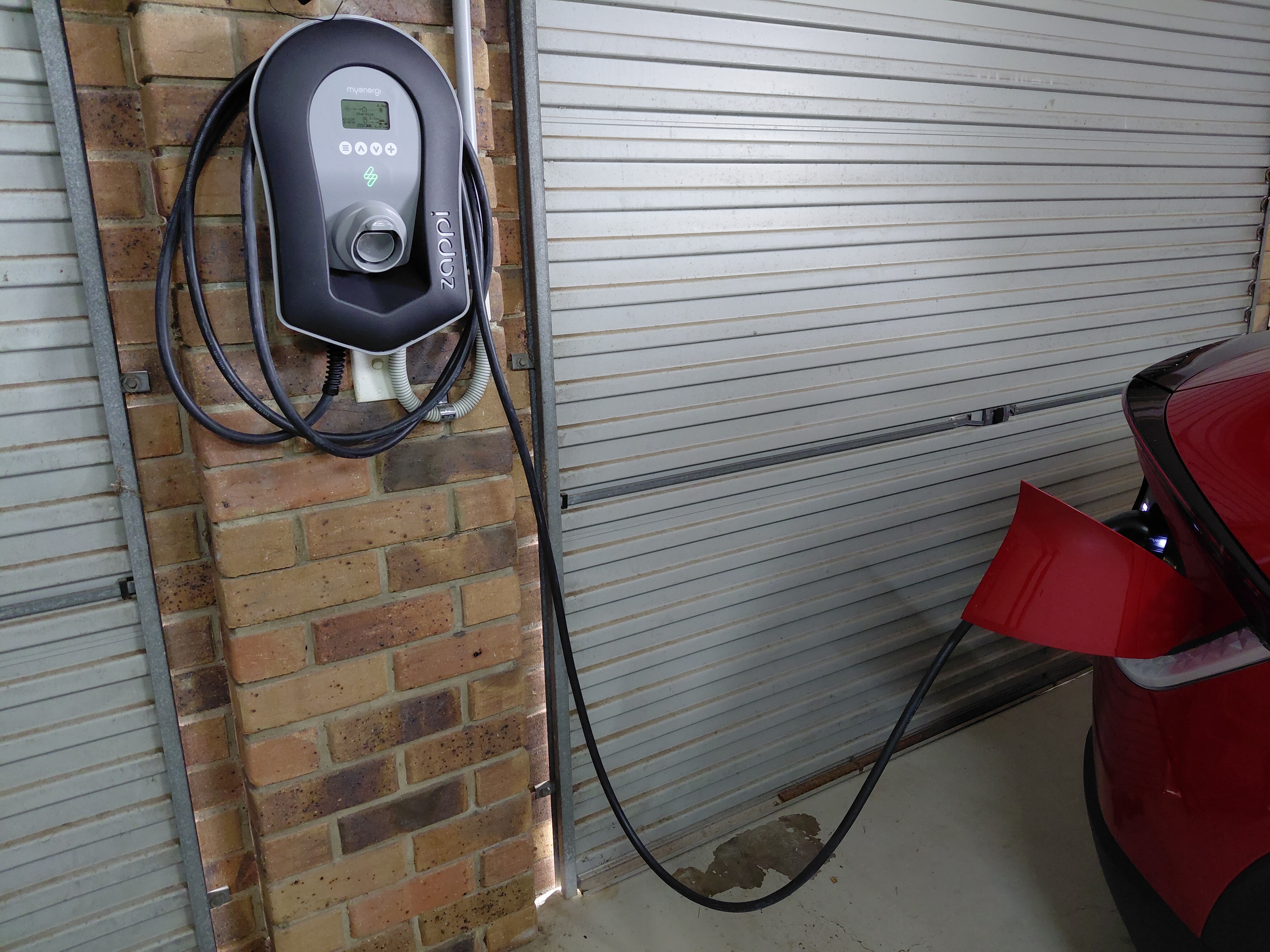
Zappi integration does require internet connection for those more security conscious than me.
I hope these pics aren’t too large.
Zappi integration does require internet connection for those more security conscious than me.
I hope these pics aren’t too large.
My solar / battery system is to be installed in early March. @Ceasar909 are you happy with your system and with amber?
I read that it can take a couple of months for amber’s AI to “get a feel” of one’s usage patterns but I recall that you are manually monitoring your use and feed in.
I’m happy with my system, home assistant runs it beautifully, including EV car charging. I don’t let Amber’s AI control it. I don’t buy more than 1kw daily at approx 5 cents. (The inverter takes time to even out load changes during curtailment and occasionally draws 100watts off the grid)
Amber. Hmmm. No price spikes in the last 4 months. There have been 5 days where before lunch a spike was threatened in the evening but everything fizzled out and was near normal pricing. Bad for me, good for the grid in general. The Amber support team is super busy with new connections or so it would seem.
It may be better to stay with a standard company and not pay the extra $25/month and then get just export export export all the spare. But that a) doesn’t really help the grid, b) doesn’t really fit the homelab mindset of I can do better (if I understand the ‘need to tinker’ mindset correctly)
Thanks for that but we never take the easy option. 
So. I hit a price spike. And I like my setup and am displeased with Amber.
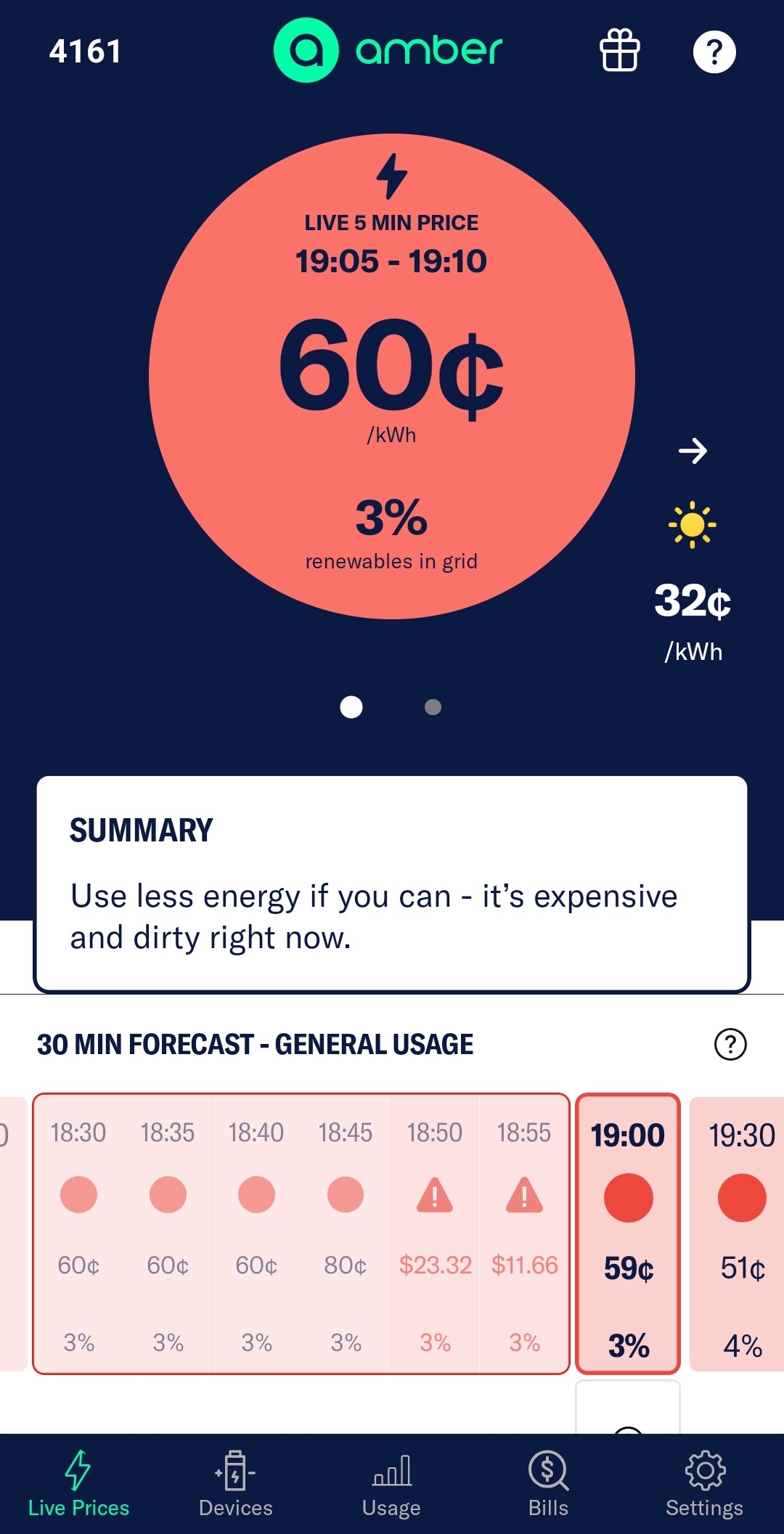
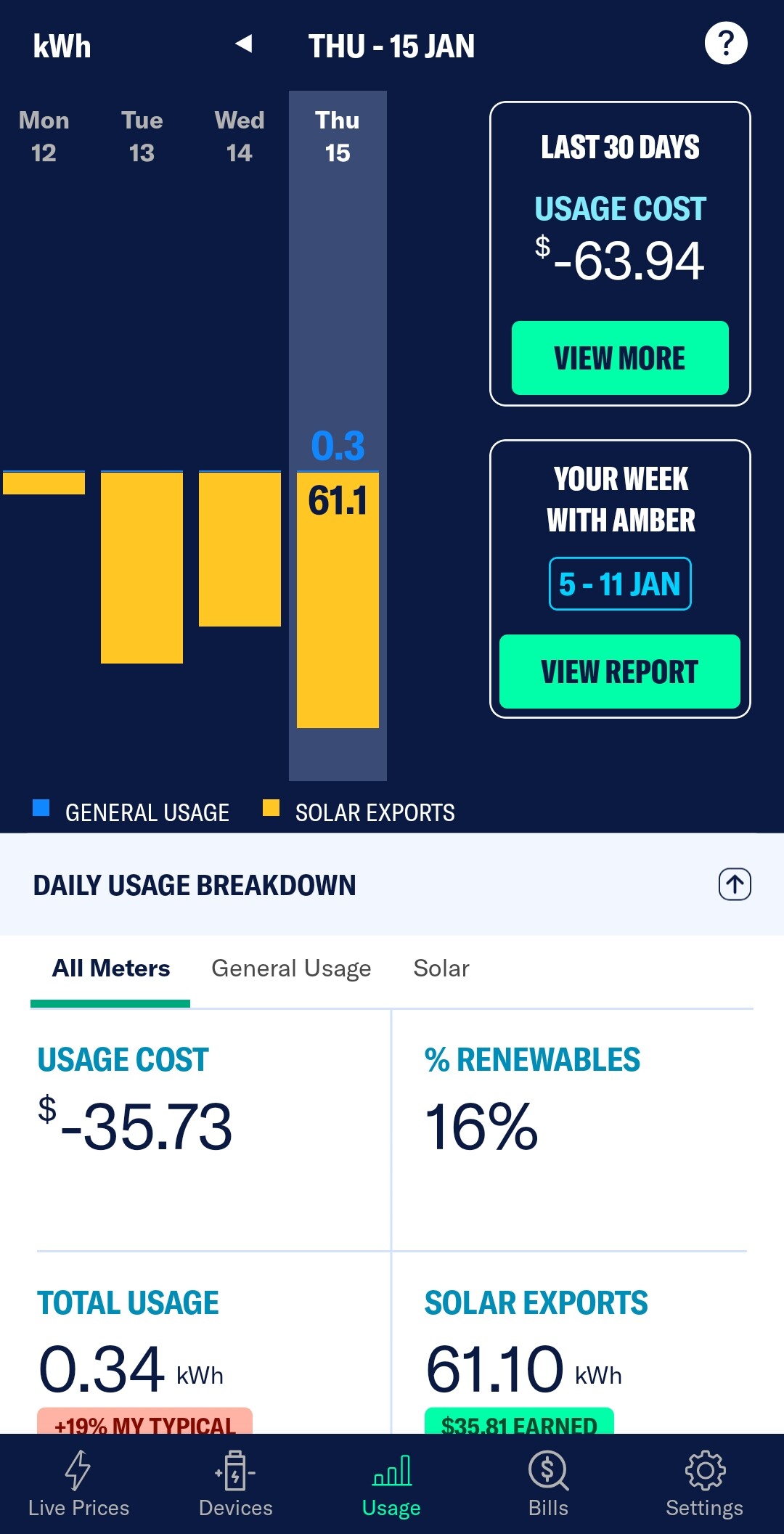
During the day I had a quick check of forecast prices. No warning. Then at 1903 I got a text from amber while strolling on the beach (on holiday). “The wholesale price is spiking, reduce power “
Off into the amber app and the price had been spiking for 13mins already. $23 bucks to buy power, and it had already passed.
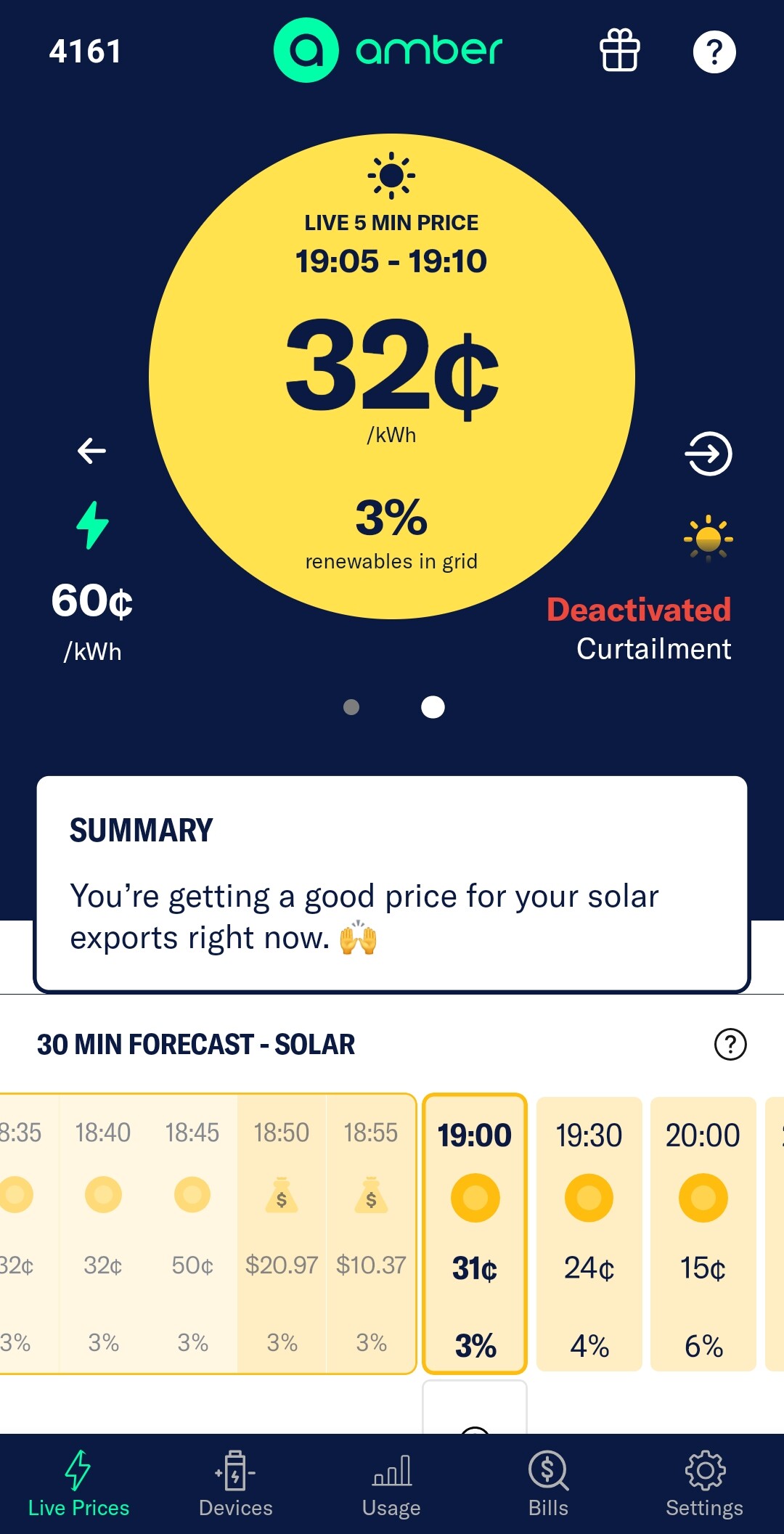
Changing to the sell price. Woohoo $20/kwh. But only for 5 mins. But some very juicy FiT’s on either side anyway.
And finally the how much money did I make. $35 bucks, all whilst on holiday cause home assistant just works. Thanks @Belfry I owe you a coffee.
So that’s my journey with Amber. Nothing super extravagant, that’s the 1st price spike in 3 months and it lasted much less than 30mins. Would their AI have automatically kicked in, dunno. Their notification was waaaaaaay to late.
I was interested in why spikes develop and why there are so short lived. Perplexity gave me the answer of a sudden surge in demand, generator outages, interconnect limitations and low renewable reserve. They are short lived because the spot price rises to a very high level to incentivise fast start generators and batteries to feed in to ensure supply and once that demand is met the price falls rapidly.
Given the increasing penetration of home batteries ready to supply the grid it would seem that spikes may be less frequent and probably not as high in the future and while batteries are a good solution to short term energy supply problems they are not the sole long term solution to Australia’s electricity requirements.
The bottom line is that I don’t think I’ll make my fortune in electricity generation.
I found this interview with Amber Electric COO Neil Luo insightful and also reassuring.
Neil noted the five fold increase in sign-ons at Amber in 2025 that followed the introduction of the solar battery scheme. The update greatly exceeded Amber’s expectations and as a result their customer service was overwhelmed. That is being addressed but he hinted that more technical users are better able to sort out the various issues that arise. I hope that’s the case for me.
He also discussed the issues with predicting demand and how aggressive the individual customer wanted to be in chasing feed in payments. He noted that predicting grid requirements should improve with the addition of more data points last year (from 6 to 70).
One thing I did not understand was the fees charged. I new about the Amber monthly payments and understood usage and infrastructure fees. I was aware of the possibility of negative feed in payments but I wondered if there were other charges I was missing.
The video concludes by mentioning the availability of Amber referral codes. Anyone got one? 
mates.amber.com.au/5CA7W3DH?utm_source=amber&utm_medium=app&utm_campaign=AE537_Multi_Traffic_Generic&utm_term=&utm_content=referral_share_link
I’ll just be first to put a link in. Now to go watch the interview.
@zeeclor would you like to see a copy of a bill? Know exactly what you’re getting into (as long as they haven’t changed any plans.
Thanks @Ceasar909, I would like to see a copy of the bill. I have signed up for Amber but it will be another month before I get hooked up. I have used your referral link so hopefully you will see a discount in March or April.
Also, sorry for the last Thursday night when we got into the weeds on some esoterica and didn’t get around to more sunny topics.
I’ll upload a copy here once I have scrubbed the personal identifiers out.
Re the in person meeting. I decided to bus to and from so I had a fairly firm exit time. I at least had heard the term github before, so I could follow from a (vast) distance.
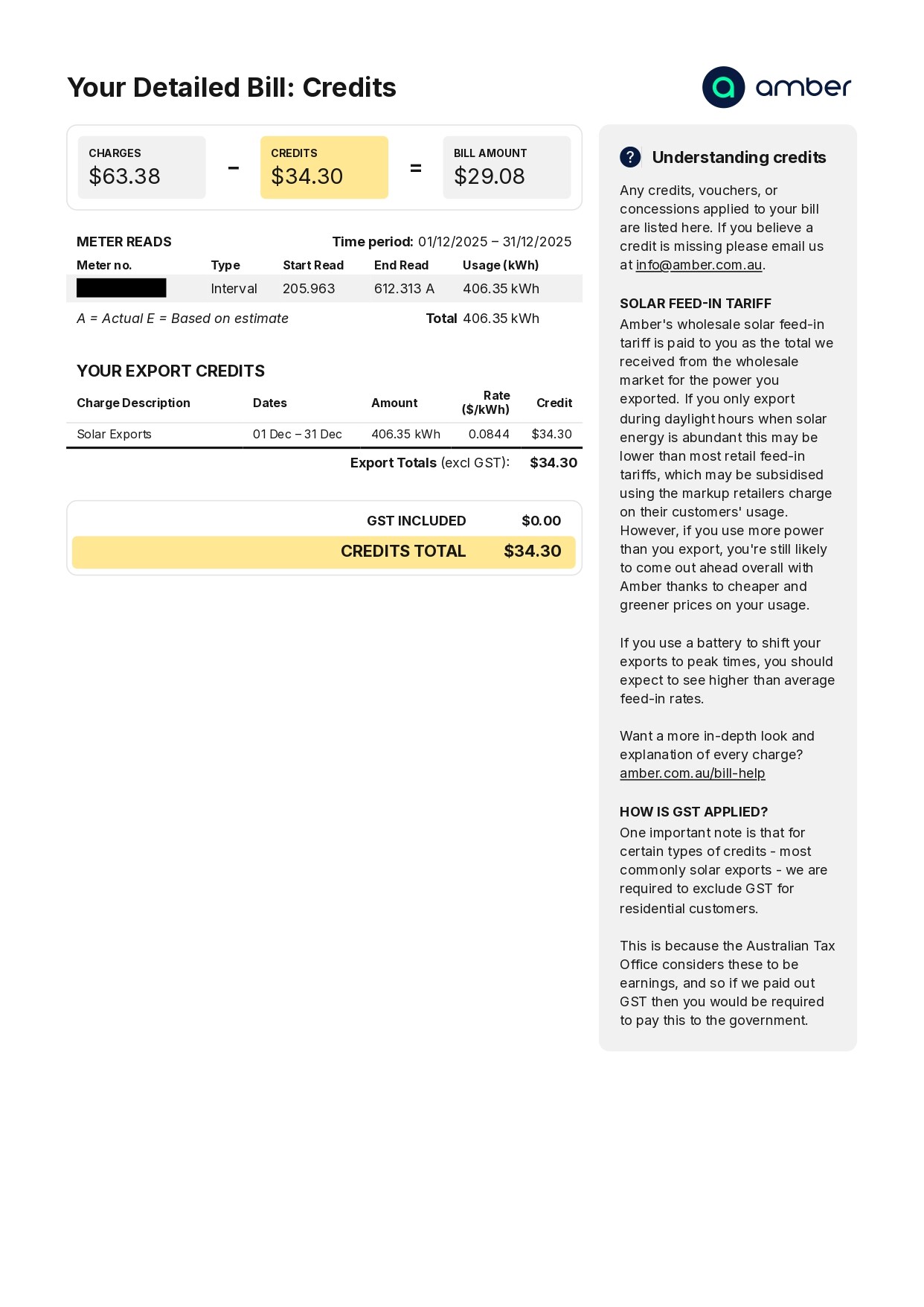
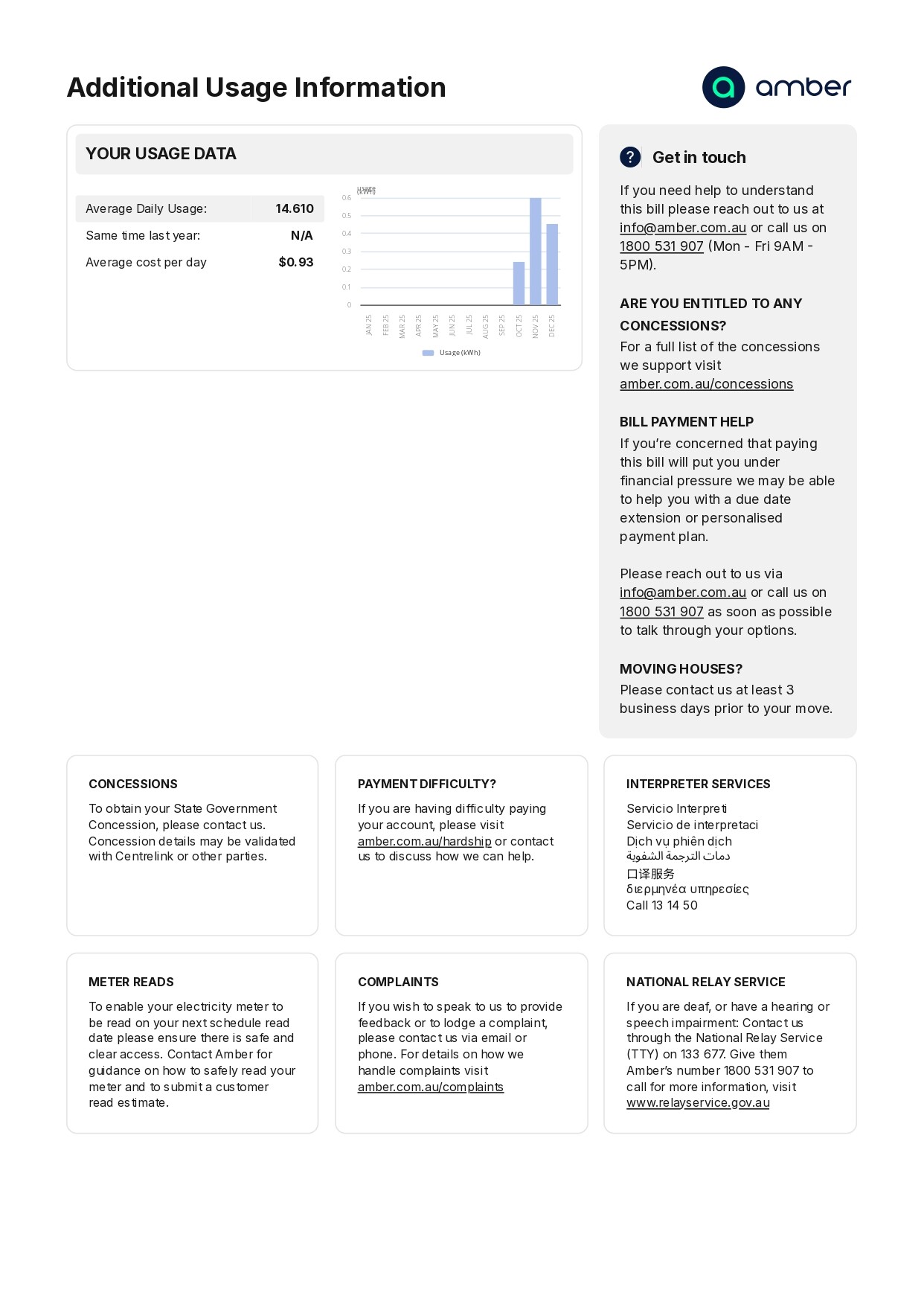
@zeeclor I hope this works and is readable.
(Edited by Belfry 28/1 - Files renamed as that looked like it may have been an account identifier in the file name)
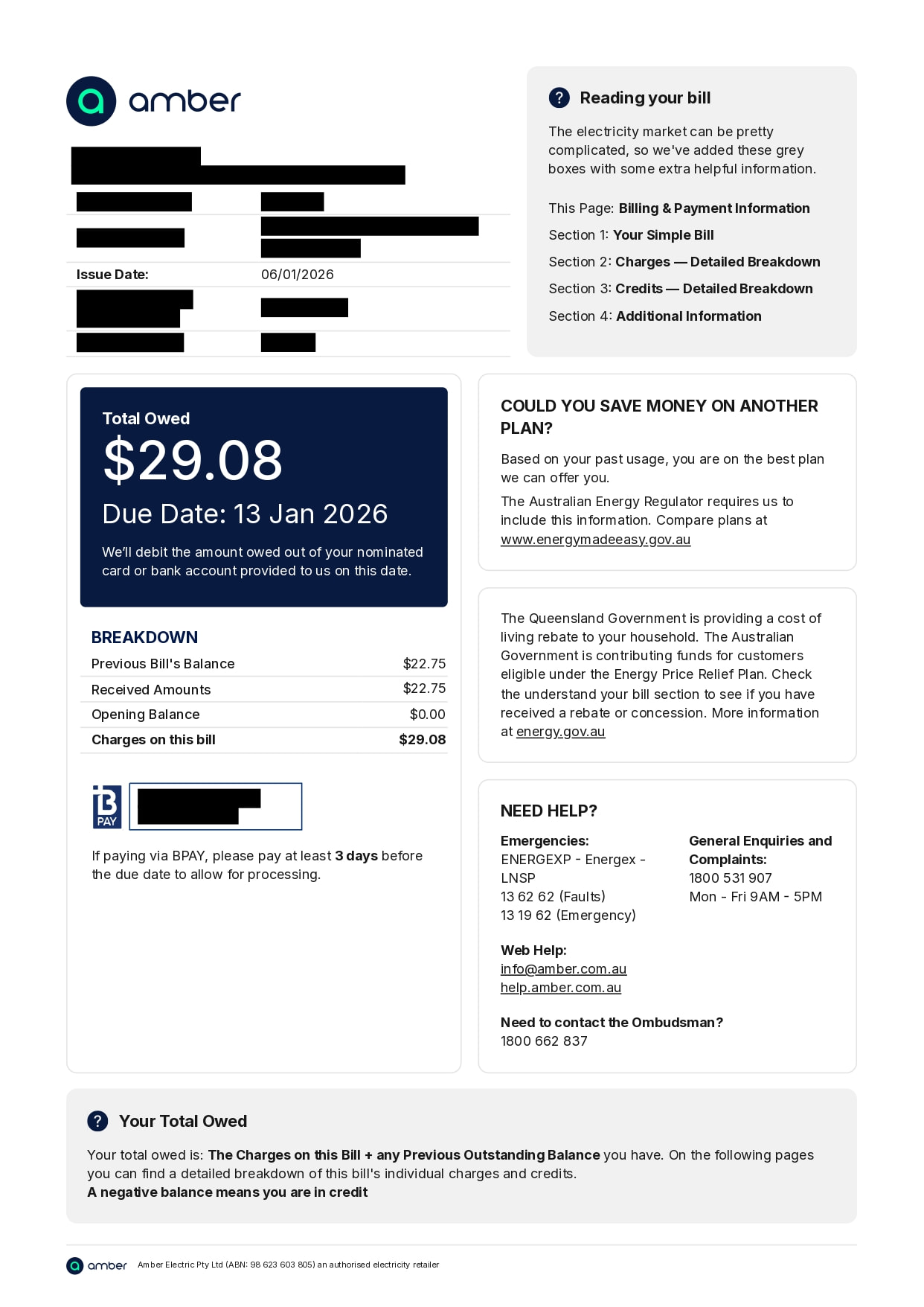
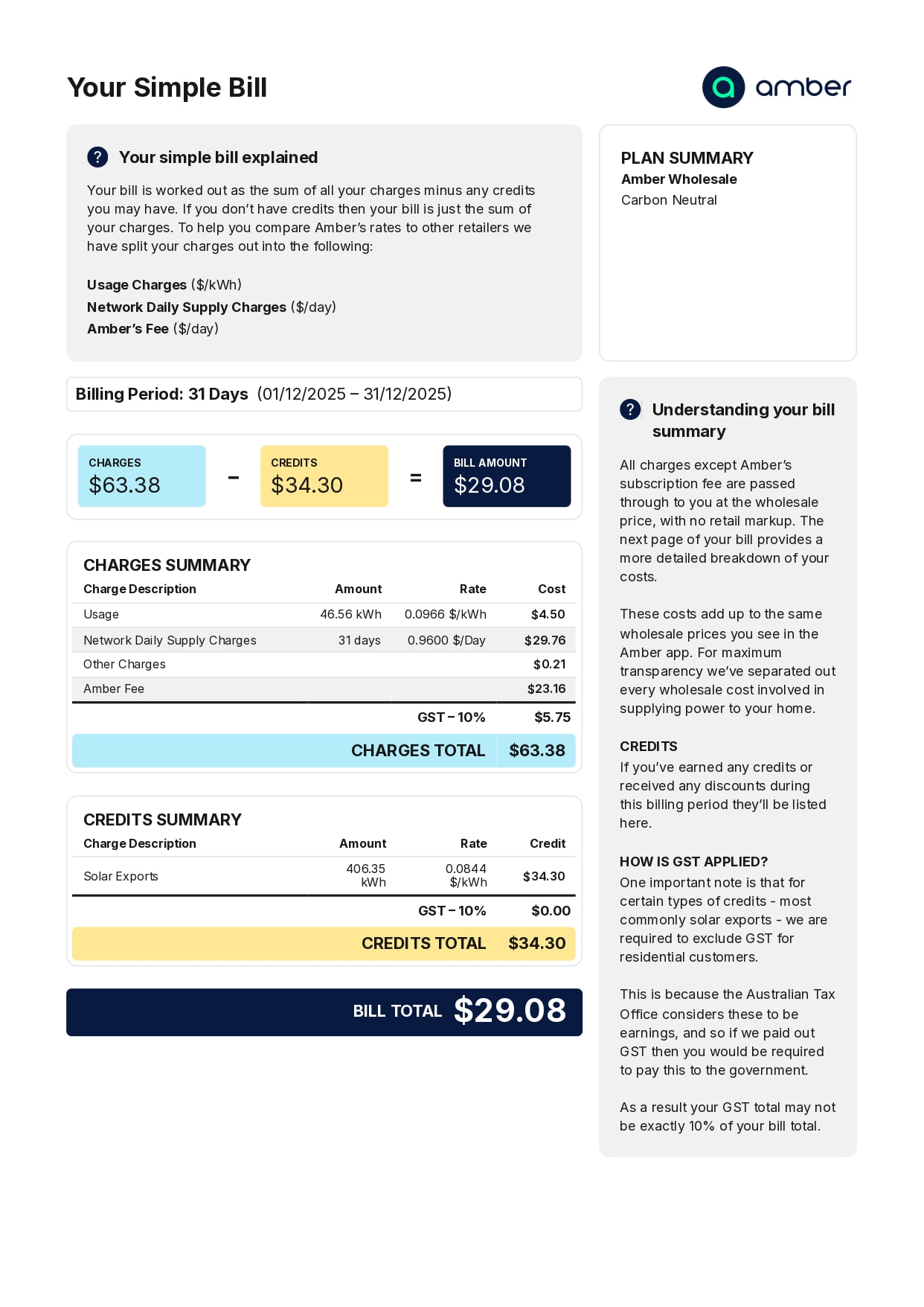
Thanks for that. That bill makes it pretty clear.
In summary you are billed monthly.
You have fed in 406.35 kWh at an average price of 8.44 cents per kWh for $34.30.
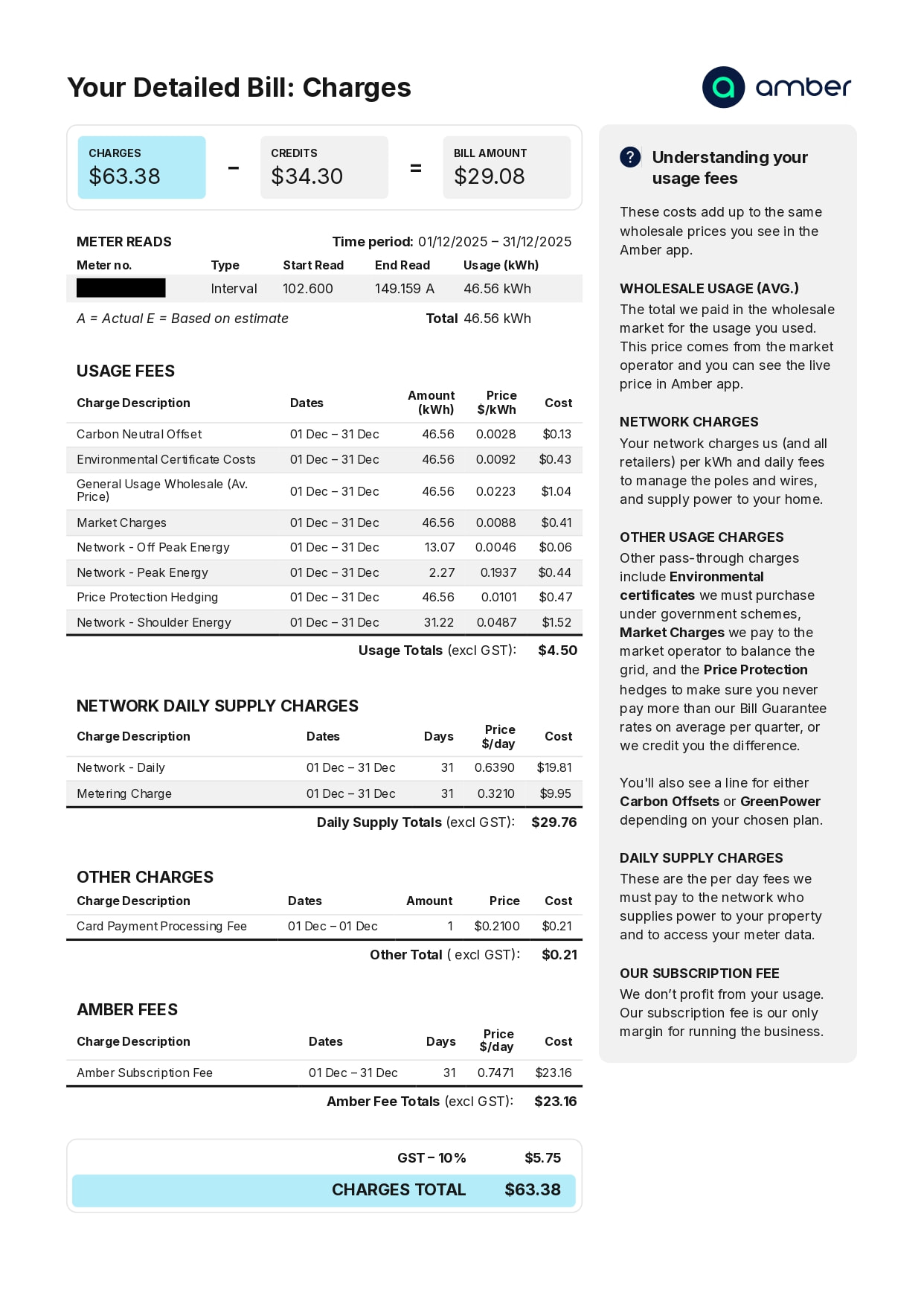
Usage charges for consumption vary depending on the time of day. Peak is 19c, shoulder 5c and off peak 0.5c (rounding). You have largely avoided peak periods. You have consumed 46.56 kWh for $2.02.
There are standard charges like credit card, amber monthly fee and network charges. The network charges are divided into poles and wires, and the metering companies get the metering charge.
I note that your daily network charge came to $0.96 per day. I compared mine and that was $1.414380 per day.
Other “usage fees” combine market charges (balancing the grid), carbon neutral and environmental certificates, that are stipulated by the government, and price protection hedging sounds like a great idea if it only costs 47 cents per month. It was not really clear to me what the "General Usage Wholesale (Av.Price) was but apparently it’s the cost of generating the power rather than getting it to you.
Looking at the pricing I presume you have mostly contributed power at peak times, making sure your batteries are full at 4 pm and run them down over the next 5 hours. Hitting a spot peak during the early evening for 5 minutes makes some money and if you have a big inverter you can make even more money (while the sun doesn’t shine).
A friend of mine has recently installed a new battery / solar system. Mine is bigger than his. He suggested I should go off grid. He was mostly joking but I have another mate who lives in the bush and he has been off grid for five years. He’s a bit of a greenie so he just needs enough for the lights and TV. He doesn’t have a NAS.
They seem to be tacked onto the KW/h that I’ve purchased. I bought 13KW/h off peak, 2KW/h peak and 31KW/h shoulder which add up the the 46 units that I have been charged for; Carbon, environment, hedging etc. Buy less power pay less charges. Except the daily charge, can’t get away from that one. To be fair, I think they are all summed together in the amber app including the wholesale price as the listed price to purchase (or negligible enough to not worry about anyway)
Looking at the pricing I presume you have mostly contributed power at peak times, making sure your batteries are full at 4 pm and run them down over the next 5 hours.
Generally yes. Power the house from battery only from 4pm until the sun is up the next day and sell down to a specific battery percentage to reserve for own usage if the price is good.
Mine is bigger than his. He suggested I should go off grid.
It’s soo tempting. But unrealistic. With the power demands of the ‘home lab lifestyle’ and giving up the chance to export power just to not pay a poles and wires tax. Then the risk of a tropical cyclone and 5 wet days in a row. Well, unrealistic for me and my household even without the EV.
But oh so tempting.
(Thanks @Belfry)
One thing I forgot to ask since it doesn’t show up in your bill, does home assistant give you your self-consumption values?
Great question. I don’t particularly track this figure. Looking at the Mkassiar integration, the generic dashboard, all the required data is there for you. Daily generation, consumption, import and export values as well as lifetime totals for those categories.
The generic Home assistant energy dashboard also has those graphs prebuilt (not working correctly for me).
As a follow up to this topic on analysing your Amber bill, I saw Neerav Bhatt put this out yesterday.
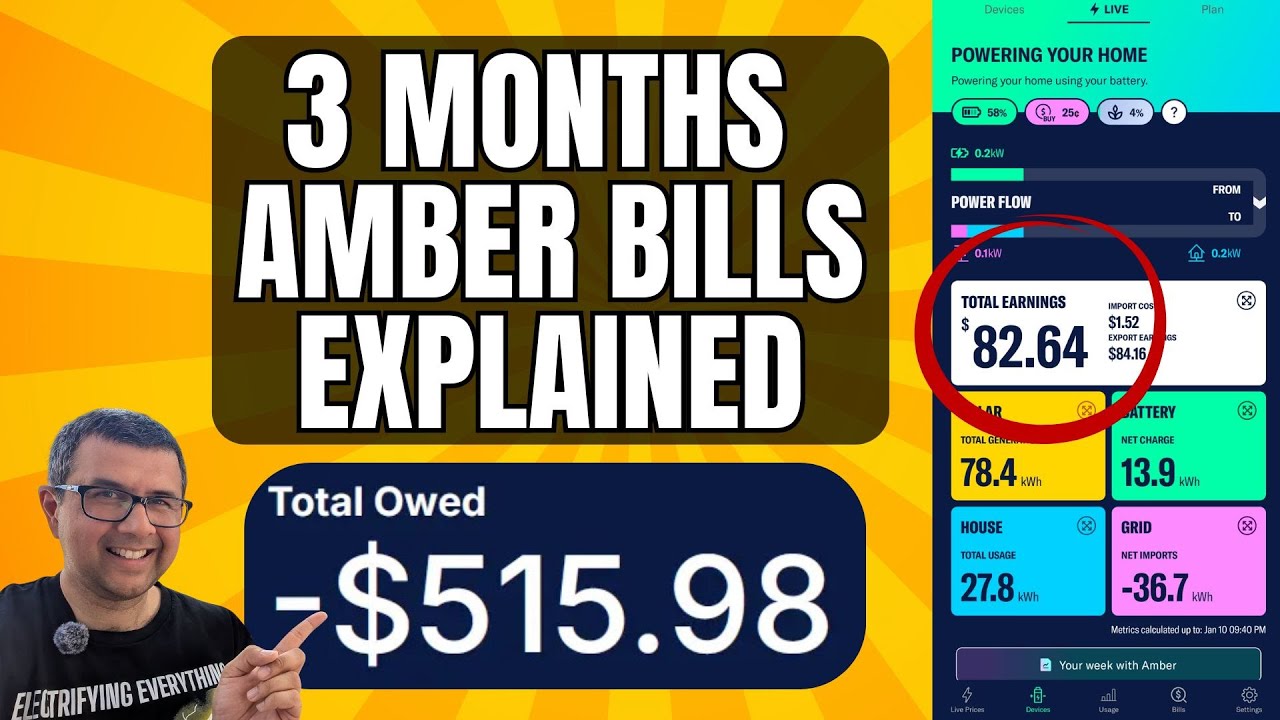
He is doing pretty well in the Sydney market particularly when supply was being challenged by hot days in December.
He doesn’t hide it but the Amway component of his income is increasing and should improve further after this video.
It’s a good thing that that only lasts 12 months.
I think he says the salient point in the first 5 mins. It really does depend on where you live. State vs state. NSW seems to have a worse grid than QLD with more spikes and higher general prices.
He doesn’t really get down into the nitty gritty of how many and how large the price spikes were. He just rolls straight into Amber smart shift now knows how I use my battery. Hrmmmm.
At least he is honest about how much is coming from the referral scheme.
My solar, battery and EV charger installation is scheduled for the coming week. I followed the recommendations above and have gone with Sungrow.
I am also redoing my home assistant configuration from scratch. The default is fairly drab and I seem to have lost the cool looking Sankey chart I previously had for power flow. (?Lost when the GoodWe inverter was decommissioned.)
There are lots of HACS that one can add in. What are HLB’s top recommendation?
Exciting exciting. I hope it all goes well for your installation and they put the roof back in one piece. Is it an inside or outside install. We got lucky and had just enough space to find a legal spot in the garage.
I just use the default mkassier dashboard and graphs for the power.
Another vote for the excellent GitHub - mkaiser/Sungrow-SHx-Inverter-Modbus-Home-Assistant: Home Assistant integration for Sungrow inverters: SH*RT series (SH10RT), SHx.RS series (SH3.RS), SH*K series (SH4K6), SxT-series (S20T) project.
I note that there’s been a rewrite in January, but I’m using the “2025-legacy” branch (discussed on the front page) and haven’t tried the newer version. My inverter wasn’t officially supported and had a bunch of strange instability, including after a firmware update and updating the WiNet-S adapter. I ended up cutting down and tweaking the [2025-legacy] yaml and made my yaml for the sensors (see my post above from Dec 2025). If I’m feeling brave at some point, I might back up HA and try the newer re-written version of the project to see whether I can get the full feature set going.
If you aren’t already doing so, grab the S100 adapter with your Sungrow setup (or at least a device that does something similar). It was the thing that saved the day for whole of house energy monitoring - I could use the data from that device to track the consumption/import/export in Home Assistant all via the above integration.