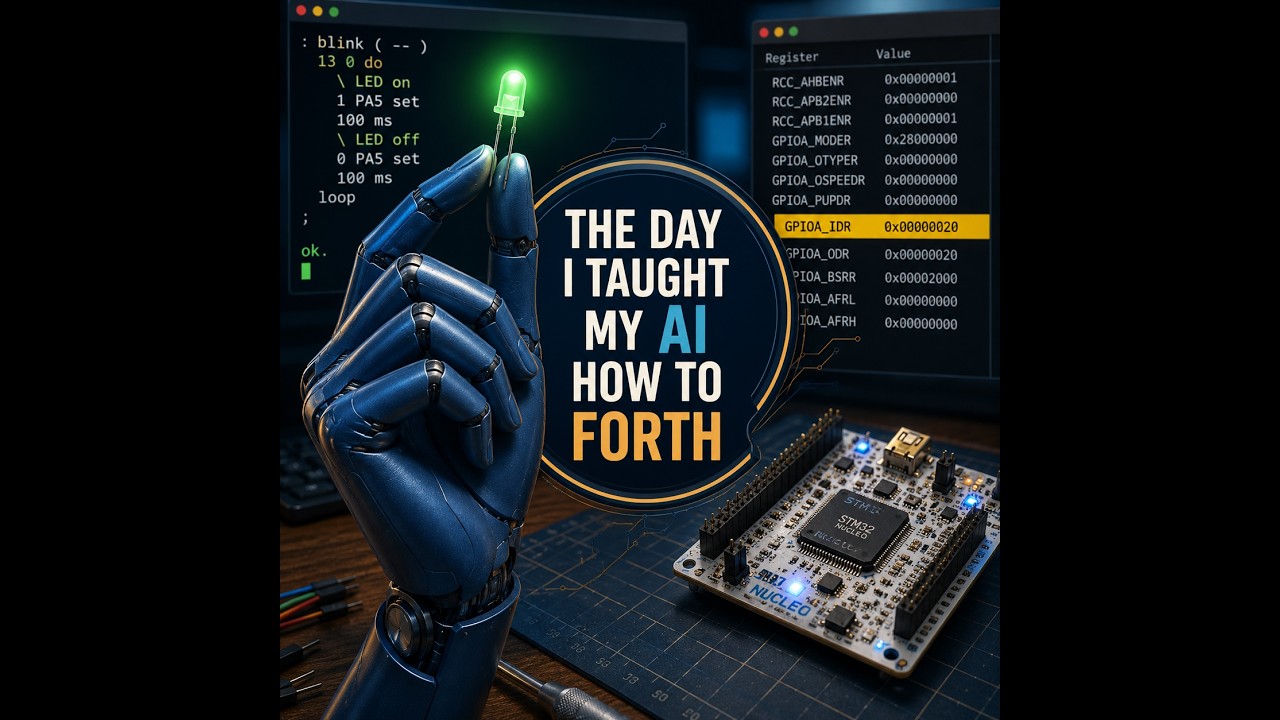
The day an AI learned what Forth actually feels like — on real silicon, with a seventy-two-year-old electronics technician in a shed in New South Wales watching over the debug wire.
This is the story of a genuinely new kind of embedded development session.
The AI already knew Forth — it can write Forth faster than any human alive.
What it had never done was use Forth on real hardware, because the classic embedded-C loop — write, compile, erase, flash, run, wait, guess, repeat — is impossible for an AI to work inside. Every round-trip destroys its context. The rover-on-Mars problem: tell it to stop, and the signal arrives fourteen minutes later, after the rover has already driven off the cliff.
Forth removes the time problem. It compiles on the chip and runs instantly.
Type a word, the silicon answers in milliseconds. The feedback loop finally matches the AI’s context window — and the whole C-era floundering disappears.
But even with instant feedback, the AI had no training data for the
embodied half of Forth: compiletoflash vs compiletoram, bis! needs a mask
not a bit number, BSRR is write-only, and the calltrace that stops the endless 00000003. That part lives only on a bench. So the human taught the AI the silicon — while the AI brought the grammar and the speed.
And every result was verified by Regmon — the register monitor that reads the chip over the debug port, independent of the CPU running the Forth. Two paths, one answer, no guessing. Turn the green LED on, and the register flashes yellow because the silicon changed.
Once anyone — human or AI — can turn an LED on and off with Forth, they have opened the Forth door for themselves. This is that day.
The AI didn’t need to be taught Forth. It needed to be shown the bench.
Produced with the help of AI without which this video would not have been possible