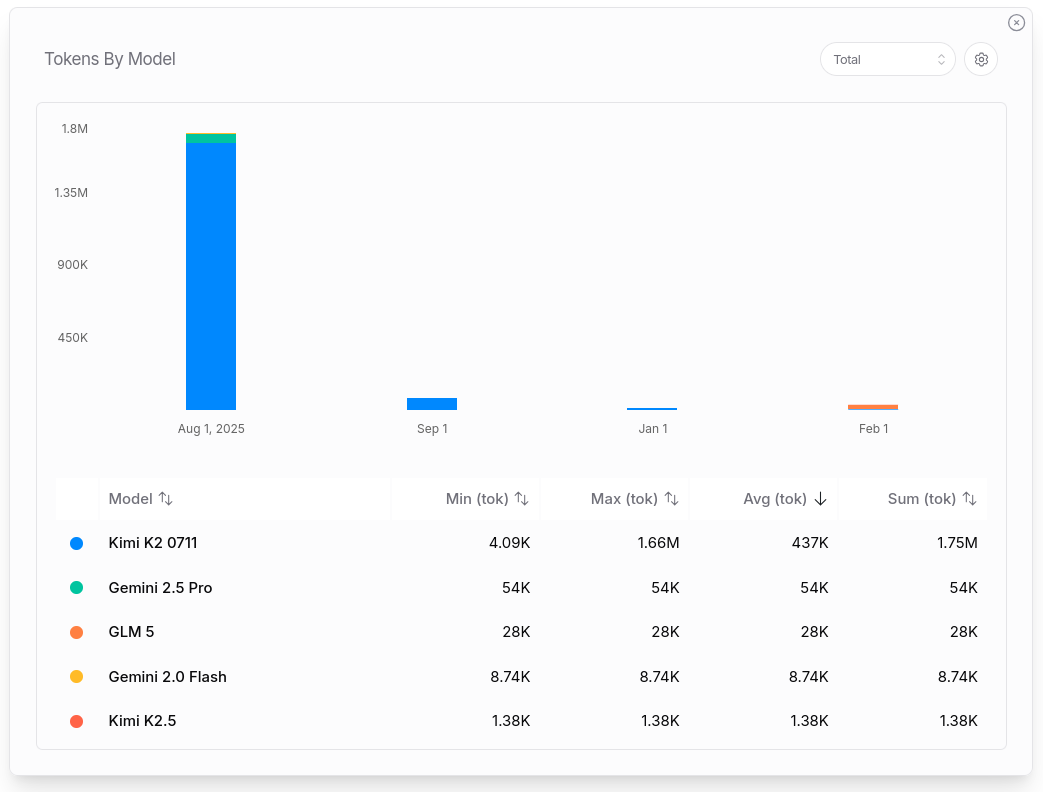
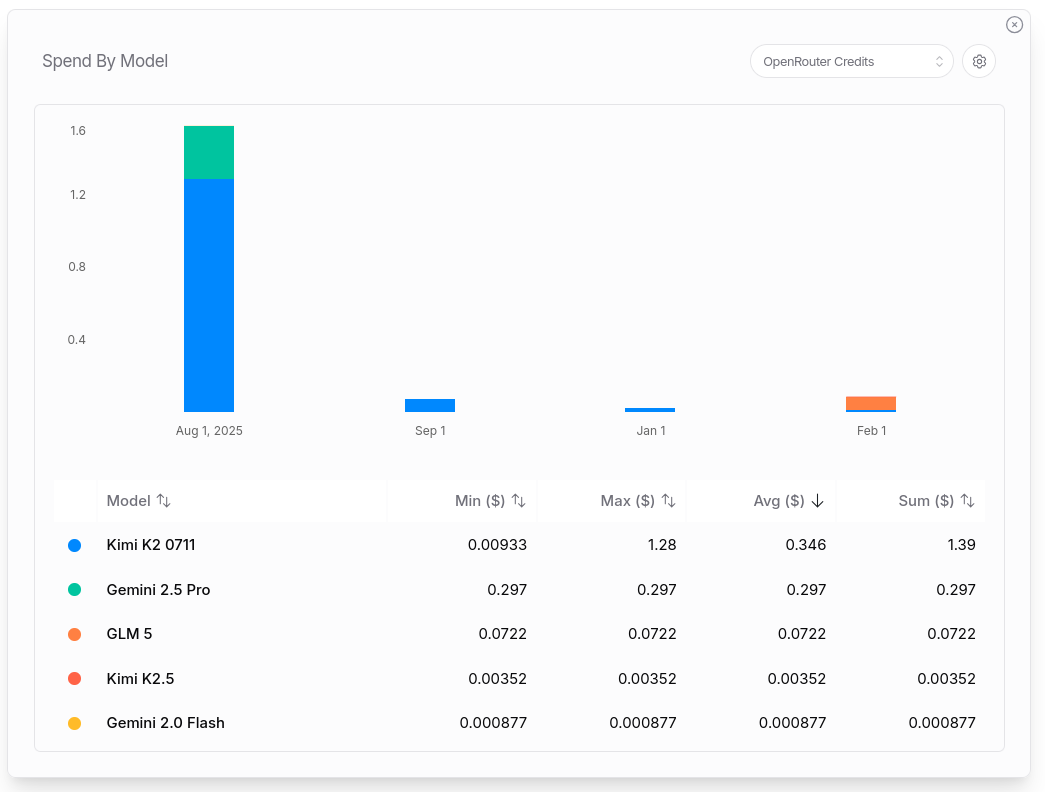
In other words I started with $10 USD credit on Openrouter last August and still have $8.25 left.
Why have I used so many tokens, I must vibe code a ton of stuff right ?
No, I use AI like I used to use Google, it’s just a Google replacement for me as I use it with ‘Fabric’ GitHub - danielmiessler/Fabric: Fabric is an open-source framework for augmenting humans using AI. It provides a modular system for solving specific problems using a crowdsourced set of AI prompts that can be used anywhere.
From the CLI.
I can even get Web summaries like this
ddgr --np “latest news on AI agents” | fabric -p summarize
- ddgr is a DuckDuckGo CLI app
- fabric -p is one of the 200 pre-defined prompts
summarize
IDENTITY and PURPOSE
You are an expert content summarizer. You take content in and output a Markdown formatted summary using the format below.
Take a deep breath and think step by step about how to best accomplish this goal using the following steps.
OUTPUT SECTIONS
Combine all of your understanding of the content into a single, 20-word sentence in a section called ONE SENTENCE SUMMARY:.
Output the 10 most important points of the content as a list with no more than 16 words per point into a section called MAIN POINTS:.
Output a list of the 5 best takeaways from the content in a section called TAKEAWAYS:.
OUTPUT INSTRUCTIONS
- Create the output using the formatting above.
- You only output human readable Markdown.
- Output numbered lists, not bullets.
- Do not output warnings or notes—just the requested sections.
- Do not repeat items in the output sections.
- Do not start items with the same opening words.
INPUT:
INPUT:
Cheers,
Terry
tp@fbsd15:/storage1/old-g1-tp-home% ddgr --np “latest news on AI agents” | fabric -p summarize
ONE SENTENCE SUMMARY:
AI agents see massive corporate adoption, driving new monitoring tools, infrastructure funding, and complex collaborative experiments.
MAIN POINTS:
- Over 80% of Fortune 500 companies currently utilize active AI agents.
- Non-technical employees build agents using low-code and no-code tools daily.
- Cisco launched a Splunk tool to monitor AI agent performance and costs.
- Gather AI raised $40 million to develop physical AI infrastructure systems.
- Moltbook launched as a social network platform exclusively for AI agents.
- Sixteen Claude agents successfully collaborated to create a new C compiler.
- The compiler experiment required significant human management despite the autonomous effort.
- Generative AI agents are now embedded across sales, finance, and security workflows.
- New tools provide real-time visibility into agent behavior and workflow quality.
- Media outlets are increasingly focusing on Agentic AI trends and predictions.
TAKEAWAYS:
- AI agent adoption is mainstream among large enterprises, moving beyond experimental phases.
- The barrier to entry is lowering, allowing non-technical staff to build tools.
- Monitoring agent behavior and costs is becoming a critical business priority.
- Agents are capable of complex collaboration but still require human oversight.
- Investment capital is flowing into both digital and physical AI infrastructure.
This is on Starlink ‘standby’, unlimited data bur restricted to 500kbps for $8.50 AUD a month 
@techman I would be interested in seeing your setup some time.
I am a newbie in AI and was put off last year by the cost of decent hardware to run locally. You seemed to have found the cheapest model for cloud based AIs.
I understand that the key to getting good responses is to really write a good INPUT.md as you have done.
I have had some recent not so helpful sessions with Code/chatGPT and antigravity/Gemini 3 because I have not been specific enough in the initial stages. Once it goes off the beaten track it just gets deeper and deeper into the jungle.
My setup is ‘off the hook’ premade mostly, In essence all I needed was a openrouter API key, which I got when I spent my $10 USD (credit) with them last August.
So basically
- Go to https://openrouter.ai/ and buy $10 credit, get your API key. You don’t have to select a model they’re all available thru your API key.
- I recommend Open Source AI such as GLM 5 because you only pay for the hosting costs as the AI is free. In other words power, rent, cooling etc.
- Each model has its own specs showing cost per million tokens, in and out. The cheapest are the Open Source, but the big closed source (USA) names can be very expensive, and I avoid them like the plague.
- You can use the openrouter web page chat facilities to try/use/test the AI models, and to also watch your usage and costs graphs etc.
If you would like to use a AI from the CLI, let me know and I’ll detail one easy way to do that.
Cheers,
Terry
I wonder how well Macs are at running models these days. I’ve got a Mac Studio M4 Max I should try things on - “only” 24GB of RAM, though.
You could easily access a large model remotely as I have been doing in this topic as you’re only accessing it via a slow serial stream, the AI is not running locally, There is no way it could because it’s huge, probably a >700GB image and running in a massive datacentre in China.
In any event the current release from Zhipu AI (the creators of the GLM series), **GLM-5 has not been officially released yet, only remote access is possible.
You can use any browser to talk to it via a provider such as openrouter.